|

![]()
![]()
Use the Toolbox for a variety of unique resources for organizers.
![]()
![]()
![]()
Making The Fine Print Fair! Citizen Works has launched the Fair Contracts Project, built with a team of law students and lawyer volunteers around the country currently looking at the fine print and harmful consumer provisions in standard form contracts across several industries.Visit this project at
For more information on how to join our team.
Save the date: January 27, 2012: Hidden Traps, Fair Contracts & Consumer Choice
Citizen Works and the Loyola School of Law Institute for Consumer Antitrust Studies are co-hosting a panel presentation on “Hidden Traps, Fair Contracts & Consumer Choice” from 10 a.m. to 12:30 p.m. on January 27, 2012 at Loyola School of Law in Chicago. Speakers from Fair Contracts, the Consumer Financial Protection Bureau, the Illinois Attorney General’s Office, MSNBC.com, and the University of Chicago and Loyola Law Schools will participate. More details to follow.
January 21, 2012, will mark the second anniversary of the Supreme Court of the United States' landmark campaign finance decision in Citizens United v. FEC. The Court's decision opened the floodgates for corporate cash in our elections by striking down the prohibitions on corporate independent expenditures that had been settled for decades of U.S. law. See the Sunlight Foundation's breakdown of this cash in the 2010 midterm elections.
Resolve to learn more about how to control corporate power this year!
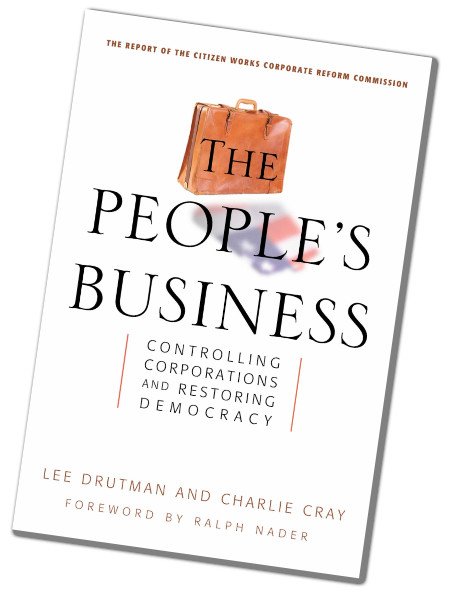
Read The People's Business to understand how corporations achieved their current privileged position (including how they came to be treated as persons with constitutional rights) and for a comprehensive approach for controlling them and restoring democracy.
Two major coalition efforts, with different approaches, seek to address the ramifications of the Supreme Court decision and can be found at MovetoAmend.org, and FreeSpeechForPeople.org.
Read Jeff Clements' Corporations are Not People
Read Ralph Nader's Getting Steamed to Overcome Corporatism Build it Together to Win.
Consumer Financial Protection Bureau/Dodd-Frank Act Update:
December 8: U.S. Senate Blocks the Confirmation of Richard Cordray For CFPB Director Spot
In a partisan vote of 53 to 45, the U.S. Senate blocked the confirmation of Richard Cordray, President Obama’s nominee to head the Consumer Financial Protection Bureau (CFPB). All 45 no votes were from Republican Senators who disagree with the underlying legislation of Dodd-Frank and how the CFPB is formulated. (This was a cloture vote to end debate on the nomination/prevent a filibuster, thus 60 votes were required to stop debate to allow the nomination vote to proceed.)
Republican Senator Scott Brown, who faces an election challenge from Elizabeth Warren, the Harvard Law Professor who was tasked with setting up the Bureau, and then bypassed to run it, voted for Cordray, and Republican Senator Olympia Snowe of Maine voted “present.” Otherwise, it was a party line vote that leaves the fledgling new agency without a head, and unable to undertake large swaths of its mandate to protect consumers.
October 10: Senate Banking Committee Approves Cordray For CFPB Director Spot
On Thursday, October 6, the Senate Banking Committee approved Richard Cordray in a 12 to 10 party-line vote to be the first director of the Consumer Financial Protection Bureau (CFPB).
The next step is for the entire Senate to vote on Cordray’s nomination. Cordray needs 60 votes in the Senate for confirmation to overcome a filibuster threat. Since May, however, 44 Republicans Senators have vowed not to approve anyone for the CFPB director spot until major structural, and damaging, changes are made to the Bureau.
Created as part of the Dodd-Frank financial reform act, the Bureau is tasked with making financial products and services more understandable and favorable to consumers. But until it has a director in place, the Bureau, which officially launched on July 21, 2011, cannot exercise the full extent of its consumer protection powers, including writing new rules banning abusive financial practices and regulating non-banks such as mortgage servicers.
October 2: Senate Banking Committee Expected to Hold Vote on Cordray’s Nomination for CFPB Director on October 6
On September 6, the Senate Banking Committee held a confirmation hearing on Richard Cordray, Obama’s nominee to be the first director of the Consumer Financial Protection Bureau (CFPB). Now it is expected that the Committee will vote on Cordray’s nomination this week on October 6. This date, however, is not yet finalized.
Senate Republicans have vowed to block Cordray’s nomination until the Obama administration makes significant changes to the Bureau, including subjecting it to the congressional appropriations process, replacing its unitary director with a five-member commission, and giving the Financial Stability Oversight Council more power than it already has to override any of the Bureau’s proposed regulations.
However, because Democrats hold the majority in the Senate Banking Committee, Cordray will likely receive enough votes to put his nomination on the Senate floor.
September 9: Senate Banking Committee Holds Hearing on CFPB Director Nominee, Richard Cordray
On Tuesday, September 6, the Senate Banking Committee held a hearing on Richard Cordray, Obama’s nominee for the head of the new Consumer Financial Protection Bureau (CFPB).
In his opening statement before the Committee, Cordray, a former Ohio attorney general, described his personal and professional background, explained what attracted him to consumer financial issues and the steps he has taken to develop his managerial skills. Cordray explained that to accomplish one of the Bureau’s central mandates, enforcing consumer protection laws, the CFPB planned to use litigation “judiciously.” He also shared that the CFPB will work to “streamline regulations and disclosures,” and highlighted the Bureau’s present efforts to consolidate the current mortgage disclosure forms into a single, understandable two-page document through its “Know Before You Owe” project.
The rest of the hearing, however, was less about Cordray and his ability to run the CFPB and more on the structure of the new agency. Senator Richard Shelby (R-AL.) only mentioned Cordray’s name once in his opening statement and focused mainly on the fact that no efforts had been made “to improve the accountability of the Bureau.” As it is structured now, the Bureau’s director has to testify before Congress twice a year and for these hearings, the Bureau must submit reports to Congress an explanation of its budget, a list of its implemented rules, and a list of enforcement actions it has initiated. Also, the Financial Stability Oversight Counsel can veto any of the Bureau’s proposed regulations by a two-thirds vote and unlike other federal regulators, the CFPB has a capped budget.
Despite Cordray’s assurances that the Bureau would act “judiciously,” and regularly consult Congress and other banking agencies as required by the Dodd-Frank Act, the Committee’s Senate Republicans remained steadfast to their earlier pledge to not confirm anyone to be the director of the CFPB until it has undergone significant structural changes. Subjecting the Bureau to the Congressional appropriations process and having a five-member commission opposed to a single director run the Bureau are among the changes demanded. If implemented, these changes would likely expose the Bureau to partisan politics and a slow and inefficient decision-making process.
Without a director, the CFPB cannot exercise several of its principal powers, including writing new rules or regulating non-bank entities such as mortgage servicers.
The date for the Committee’s vote on Cordray’s confirmation has not yet been set.
August 22: Agreement Entered With the FTC and Rules and Reports Issued in the CFPB’s First Month
On July 28, the Consumer Financial Protection Bureau (CFPB) issued four interim final rules concerning adjudication proceedings, civil investigations, procedures for the public on acquiring information from the CFPB under the Freedom of Information Act and the Privacy Act of 1974, and procedures for state officials on notifying the CFPB of actions and proceedings undertaken to enforce the Consumer Financial Protection Act. The CFPB will be accepting public comment on these interim rules until September 26, 2011.
The CFPB has also entered into an agreement with the Federal Trade Commission (FTC) to permit the CFPB to access consumer complaints within the FTC’s Consumer Sentinel database. As mandated by the Dodd-Frank Act, the CFPB will also share consumer complaint information it receives with the Sentinel database.
The FTC’s Consumer Sentinel is a database of complaints collected from several government and non-government entities. According to the CFPB, many of the complaints concern financial matters, such as credit reports and debt collection. Several state Attorneys General offices and the U.S. Postal Inspection Service are among the government entities that already contribute to the database and the Better Business Bureau, Xerox Corporation, and Publishing Clearing House are among the non-government entities. Only law enforcement agencies can access the FTC’s Consumer Sentinel complaint database.
Additionally, the FTC’s newly issued rule regarding deceptive mortgage advertising goes into effect on August 19. The rule prohibits misleading information about consumer mortgages in advertisements and other commercial communication. The FTC rule lists 19 examples of prohibited material, including misrepresentations about “the existence, nature, or amount of fees or costs to the consumer associated with the mortgage,” and “the terms, amounts, payments, or other requirements relating to taxes or insurance associated with the mortgage.” This rule will apply to all entities within the FTC’s jurisdiction that advertise mortgages, including mortgage lenders, brokers and servicers, real estate agents and brokers, advertising agencies, home builders, lead generators, and rate aggregators. The rule will not, however, apply to banks, thrifts, credit unions, or other entities outside the FTC’s jurisdiction. The CFPB will be able to bring actions to enforce this rule and on July 21, the FTC transferred its rulemaking authority under this rule and the Fair Debt Collection Practices Act (FDCPA), the 2009 Omnibus Appropriations Act, and the Fair Credit Reporting Act (FCRA) to the CFPB. On July 20, the FTC released a staff report that gave a summary of its FCRA interpretations. In the report, the FTC staff said it “anticipates that this report…will be of aid to the CFPB as it takes over many of the interpretive functions under the FCRA.”
Moreover, the CFPB has issued three reports that the Dodd-Frank Act requires the Bureau to submit to Congress. As discussed in an earlier post titled, “The Consumer Financial Protection Bureau is Up and Running,” one report investigates the difference between the credit scores consumers purchase and the scores lenders use. The next report concerns remittance transfers. Remittance transfers are when people transfer money electronically to a recipient abroad. Foreign workers in the United States often use remittance transfers to send money to their family and friends still living in their home country. The report gives recommendations for increasing “transparency and disclosure of exchange rate information for consumers making remittance transfers,” and discusses the possibility of using remittance transfer data in credit scoring. The last report details three plans the CFPB has for building, training, and retaining a qualified staff.
Occupy the Hood, Chicago Anti-Eviction Campaign, Occupy Austin, Communities United Against Foreclosure & Eviction 10.29.11 Chicago


OCCUPY CHICAGO: DAY 12, OCTOBER 4, 2011 PHOTO ESSAY


February 19 & 21, 2011, Photo Essay from Days Five and Seven from Madison, WI State Capitol:

These pictures are from the peaceful Statehouse Standoff between labor, public employees, students, and now supporters from around the country, against newly-elected GOP Governor Scott Walker and the Republican-dominated State Assembly members who are seeking to close a $137 million budget deficit this year by eliminating, selectively, without negotiation, public employee collective bargaining rights, and by proposing sweeping changes to the state's Medicaid programs.
Tens of thousands of protesters (estimates ranging from 50,000 -70,000) surrounded the Capitol on February 19, 2011 and thousands more remained in the Capitol building all week. The proposed legislation follows both legislation that passed tax breaks for businesses and a $1.5 billion pledge to repeal the corporate income tax. According to One Wisconsin Now, the Governor has promised more than $5 billion in corporate giveaways and loopholes. Fourteen Democratic State Senators fled the state to Illinois to deprive the Senate of a quorum needed to pass the legislation undermining collective bargaining and Medicaid. For more information from those organizing these protests see the Wisconsin Wave, whose tagline is "Uniting Wisconsinites against corporate rule and austerity, and for democracy and shared prosperity!"
On January 27, 2011, The Financial Crisis Inquiry Commission Issued its 662-page report, with dissents. On January 29, 2011, New York Times business writer, Joe Nocera, summed it up by writing: "The F.C.I.C. report has its strengths--and its weaknesses. It adds color to the fraudulent actions, regulatory missteps and Wall Street mendacity that we've long known about. What it doesn't do, though, is propose a satisfying theory that explains why so many people did so many wrong, and wrong-headed, things in the years leading up to the financial crisis."
The world is experiencing the worst financial crisis in a generation, if not since the Great Depression. Excessive greed and the irresponsibility of some players in the financial sector, and their enablers in law and government, have played a large role. Reckless profit-seeking by Wall Street, coupled with lax governmental regulatory oversight, has forced destructive consequences on the rest of the country.
Citizens have again fallen prey to corporate excess. In the wake of the mega-bailouts, taxpayers are right to demand effective consumer protection to prevent flagrant recurrences and to recoup corporate welfare bailouts. Congress and the President must create strong new financial regulatory controls to help prevent future disasters and protect taxpayers. The new consumer financial protection bureau is just one step in the right direction.
Citizen Works also supports two initiatives aimed at protecting consumers from abuse by the financial sector. Now, more than ever, the need for regulations and safeguards meant to protect taxpayers and shareholders is apparent.
Since early 2009, we have pressed members of Congress to reintroduce and pass a version of the Consumer and Shareholder Protection Act, a bill introduced by former Senator Paul Wellstone (D-MN), and intended to establish a nonprofit, democratically-controlled, nationwide membership association (a Financial Consumers Association) that would serve and represent the public interest on consumer issues, specifically those relating to the financial sector. Senator Schumer has now introduced an amendment (#3772) to S. 3217, the Restoring America to Financial Stability Act of 2010, that would achieve this goal.
A Financial Consumer Association would be a federally chartered, nationwide, citizen-run, membership association of financial consumers. It would serve as an institutionalized, independent watchdog for the financial industry. In addition to keeping an eye on the financial industry, the FCA’s full-time staff would monitor legislative and regulatory activities and lobby for pro-consumer reforms. It would also represent financial consumers before regulatory agencies, Congress, state legislatures and the courts and thereby serve as an important countervailing force to the power and influence of the financial industry.
We urge the implementation of a Securities-Speculation Tax, a small tax on all financial transactions that would restrain financial gambling and redirect investment towards productive enterprise.
![]()
![]()
![]()
![]()
Coming January 9, 2012: Corporations Are Not People by Jeff Clements.
Ralph Nader on the Occupy Movement, Let Them In, November 23, 2011
U.S. Autumn?! Protests popping everywhere. In DC on October 6, Human Needs, Not Corporate Greed.
Institute for Policy Studies Report, Executive Excess, The Massive CEO Rewards for Tax Dodging; Top CEO Compensation to Average Worker ratio: 325 to 1.
Check out Ry Cooder's, No Banker Left Behind
Learn More About The Shareholder Protection Act -- to empower shareholders to tell corporations to stay out of politics.
Is Wal-Mart Too Big to Sue? Lyle Denniston at SCOTUS Blog analyzes the U.S. Supreme Court's June 20, 2011 Decision in Wal-Mart v. Dukes.
Check out Lonnie Ray Atkinson's Hip Hop Song for Health Justice/Single Payer here at projectquestion.org.
On May 17, 2011, Demos released this report by John Wasik, How Safe Are Your Savings? How Complex Derivative Products Imperil Seniors' Retirement Security.
On January 27, 2011, The Financial Crisis Inquiry Commission released its 662- page report, here.
Elizabeth Warren to create the new Consumer Financial Protection Bureau. Watchdogs are calling for a promotion. September 2010 See Banksters.org
Effort to create an Independent Financial Consumers Association doesn't get a vote in the Senate. May 2010 See wallstreetwatch.org,nader.org.
Forced Arbitration: Unfair and Everywhere, Public Citizen, September 14, 2009 www.citizen.org, co-authored and researched by Citizen Works Contract Reform Team Member Zachary Gima.
Sold Out: How Washington and Wall Street Betrayed America, Essential Information, Consumer Education Foundation, www.wallstreetwatch.org, March 2009
![]()
![]()
>> More